SUBJECT FILE NO. SA-0078
BUSHI ARCHIVE
Saitō Dōsan
Saitō Dōsan
Sengoku daimyō of Mino
SECTION I -- SUBJECT PROFILE
| Name | Saitō Dōsan |
|---|---|
| English | Saitō Dōsan |
| Origin | Japan |
| Lifespan | 1494–1556 |
| Gender | Male |
| Century | 16th C. |
| Clan / Role | Daimyo |
| Title | Sengoku daimyō of Mino |
SECTION II -- OVERVIEW
He is transmitted to have been born around 1494 (Meiō 3), though there are various theories about his year of birth. He is known as the very type of gekokujō — the man who, rising from a Kyoto oil merchant, is said to have seized the whole province of Mino in a single generation.
But recent scholarship holds it likely that this seizure of the province was not the work of Dōsan alone, but an enterprise spanning two generations together with his father Nagai Shinzaemon-no-jō.
Dōsan distinguished himself in the service of the Mino shugo Toki Yorinari, and in time banished his lord's house to become master of Mino himself.
From the fierceness of his schemes he was called 'the Viper of Mino.' Around 1548 he married his daughter Kichō (Nōhime) to Oda Nobunaga (this site's id 1) of Owari, forming an alliance.
At the meeting at Shōtoku-ji in 1553 (Tenbun 22), he came face to face with the young Nobunaga, whom the world called 'the fool,' and is transmitted to have seen through his extraordinary caliber.
But in his last years he came into conflict with his own son Yoshitatsu, to whom he had ceded the headship. In the fourth month of 1556 (Kōji 2), he was defeated by Yoshitatsu's great army at the Battle of the Nagara River and died in battle.
He was sixty-three. The blade of Yoshitatsu, who had struck down his own father, ended the life of the schemer who had risen by gekokujō.
His son-in-law Nobunaga later took Mino and walked the road toward unifying the realm.
SECTION III -- CHRONOLOGY
SECTION IV -- NOTABLE STATEMENTS
“My sons will one day tie their horses outside that son-in-law's gate. It galls me — and yet, what a man.”
SECTION V -- FIELD NOTES
[A]'The Viper of Mino' — The Reality of Gekokujō
Dōsan has long been told of as the very byword for gekokujō — a man who rose from a mere oil peddler to seize the whole province of Mino in a single generation.
But recent scholarship has made clear that it is likely this seizure was not Dōsan's single-generation feat, but an enterprise advanced over two generations by his father Nagai Shinzaemon-no-jō and Dōsan.
The father built the base in Mino, and Dōsan inherited it, removing the lord's house and the shugo one after another until he climbed to master of the province.
Even so, the fact that he overcame his lord's house by force and took a province does not change. For his cold-blooded schemes, Dōsan was feared as 'the Viper of Mino.
' The name itself symbolizes the very age of the Sengoku, in which the old order collapsed before raw strength.
SECTION VI -- LEGACY & IMPACT
Saitō Dōsan is the man who most vividly embodied the spirit of the age of Sengoku gekokujō — that with strength alone, regardless of birth, one could become master of a province.
Even as recent scholarship revises the seizure of the province into a two-generation enterprise of father and son, the fact that he removed his old lord and took Mino remains a symbol of an age in which the order of status had collapsed.
It may be said that Dōsan's greatest legacy lies in having discovered his son-in-law Oda Nobunaga (this site's id 1). Dōsan's eye, which saw through the extraordinary in the 'fool' Nobunaga at the meeting at Shōtoku-ji, became the foreshadowing of the later unification of the realm.
After Dōsan's death, Mino passed to his son Yoshitatsu and his grandson Tatsuoki, but was in time taken by Nobunaga and became the base of Nobunaga's conquest.
Yoshitatsu, who had struck down his father at the Nagara River, also died of illness a few years later. The Mino the schemer built became, ironically, by the hand of the son-in-law he had foreseen, the foundation of a bid for the realm.
Jōzai-ji in Gifu City holds a portrait of Dōsan, preserving his sharp gaze to this day.
SECTION VII -- MAJOR DEEDS
- [01]Control of Mino and the banishment of the Toki
- [02]Establishment of provincial rule
- [03]Alliance with Oda Nobunaga (the marriage of Kichō)
- [04]Development of Inabayama Castle (later Gifu Castle)
- [05]Embodiment of Sengoku gekokujō
SECTION VIII -- REFERENCE MATERIALS
PRIMARY SOURCES & ARCHIVES
- PRIMARY
Mino no Kuni Shokyūki
War chronicle transmitting the course of Dōsan's seizure of the province
- SCHOLARSHIP
Saitō Dōsan and the Sengoku Age of Mino
Yokoyama Sumio / Ebisu Kōshō Shuppan
Reflects modern Dōsan scholarship, including the two-generation seizure theory
- ARCHIVE
RECOMMENDED READING
SECTION X -- RELATED REPORTS
SA-RPT
The Seizure of Mino: By Gekokujō, a Schemer Became Master of a Province
In the age of the Sengoku, Saitō Dōsan overcame his lord's house one step at a time and seized the whole province of Mino, feared as 'the Viper of Mino.' No one embodied more vividly than Dōsan the age of gekokujō, in which strength overturned birth.
SA-RPT
The Meeting at Shōtoku-ji: In 1553, Dōsan Saw Through the Greatness of 'the Fool'
In 1553, Saitō Dōsan came face to face for the first time with his son-in-law Oda Nobunaga. The youth whom the world mocked as 'the fool of Owari,' Dōsan saw at a glance to be a vessel for the realm. The father-in-law's discernment pushed the future ruler of the realm onto the front stage of history.
SA-RPT
The Nagara River: In 1556, the Schemer Was Killed by His Own Son
In 1556, Saitō Dōsan fought his own son Yoshitatsu, to whom he had ceded the headship, at the Nagara River, and died in battle. The gekokujō schemer who had seized a province fell to his son's gekokujō. The blood of father-and-son strife closed Dōsan's life.
SECTION IX -- LINKED SUBJECTS
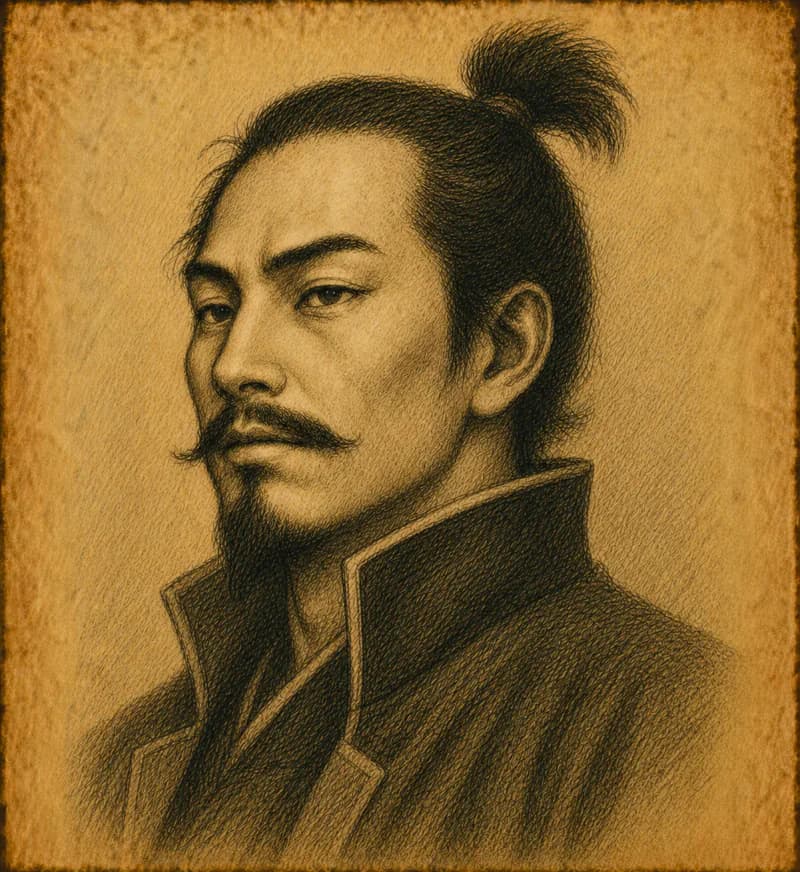
SA-0001 / JPN
Oda Nobunaga
The revolutionary who paved the path to a unified Japan
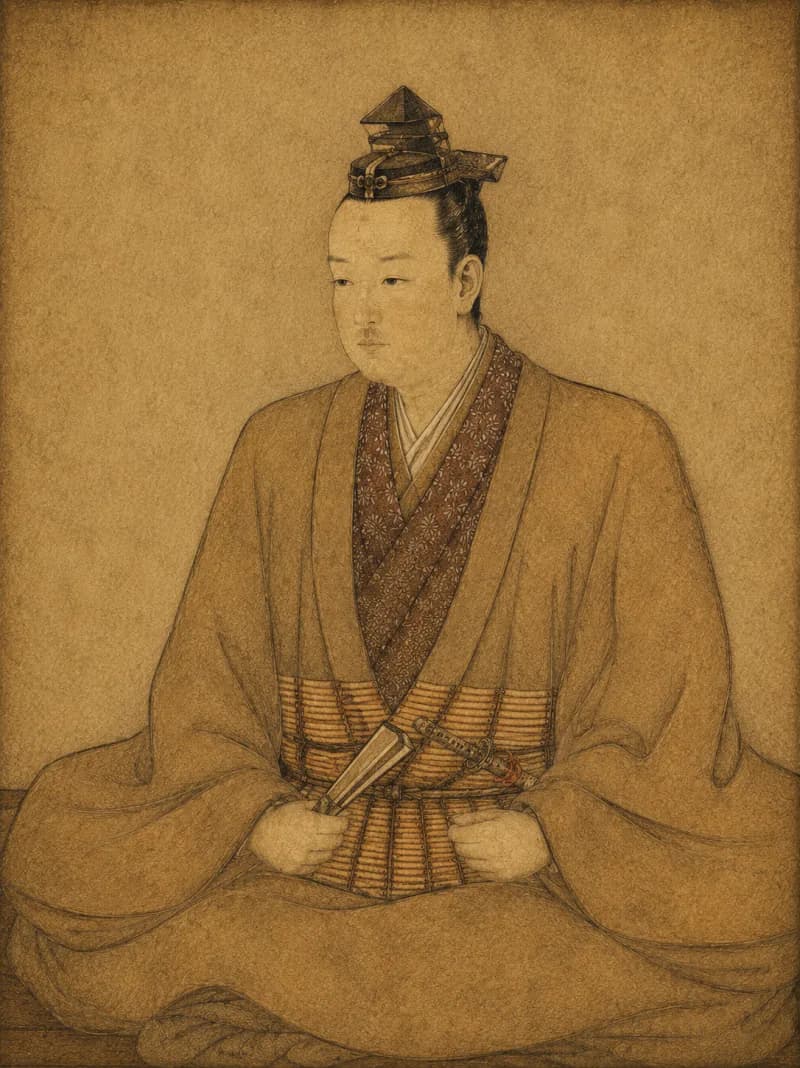
SA-0030 / JPN
Akechi Mitsuhide
The general whose betrayal at Honnō-ji rerouted Japanese history
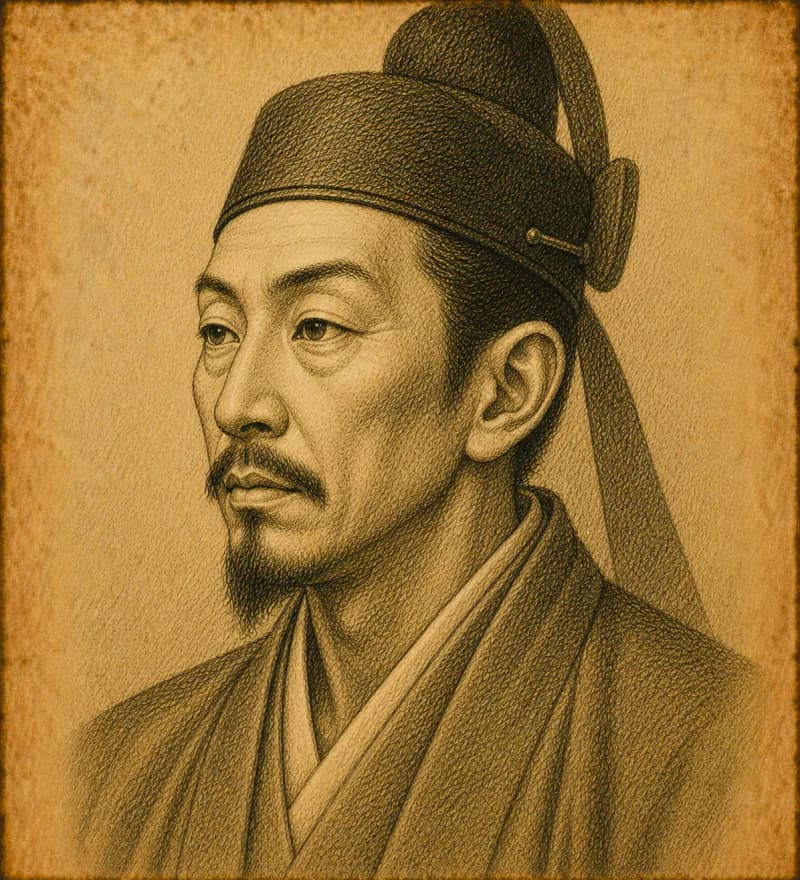
SA-0002 / JPN
Toyotomi Hideyoshi
The peasant who rose to rule all Japan
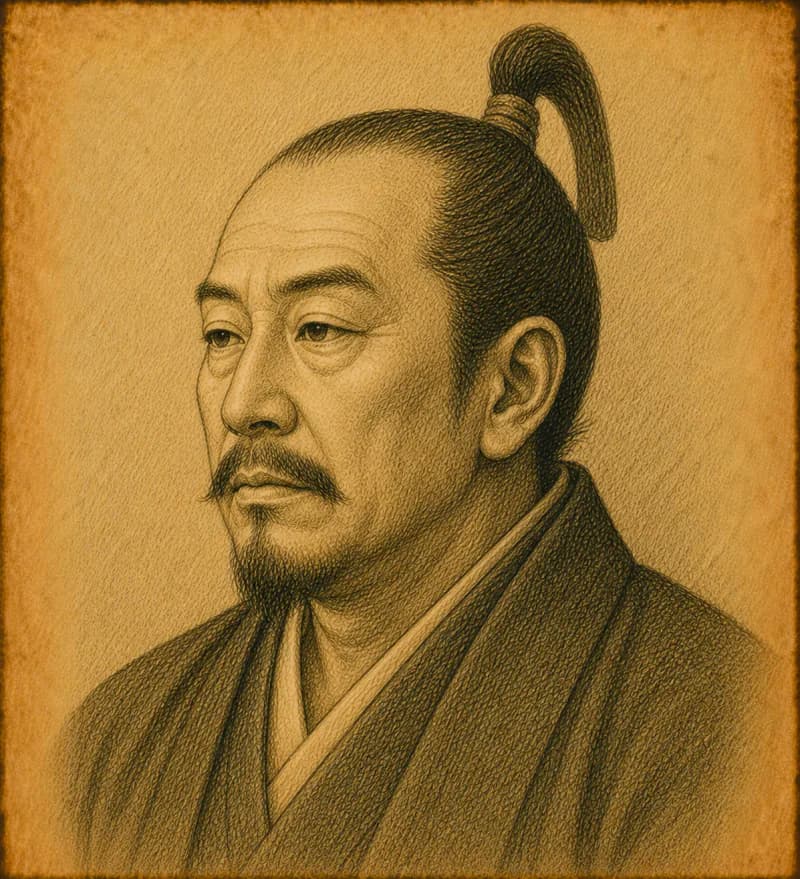
SA-0003 / JPN
Tokugawa Ieyasu
The patient warlord whose dynasty ruled Japan for 250 years
SA-0004 / JPN
Date Masamune
The One-Eyed Dragon who built Sendai
SA-0005 / JPN
Takeda Shingen
The Tiger of Kai whose cavalry shook the realm
SA-0006 / JPN
Uesugi Kenshin
The Dragon of Echigo, sword-saint of the north
SA-0033 / JPN
Takeda Katsuyori
The last lord of Takeda — and the man who lost the cavalry at Nagashino