SUBJECT FILE NO. SA-0062
BUSHI ARCHIVE
Ishikawa Goemon
Ishikawa Goemon
Legendary great thief; ninja
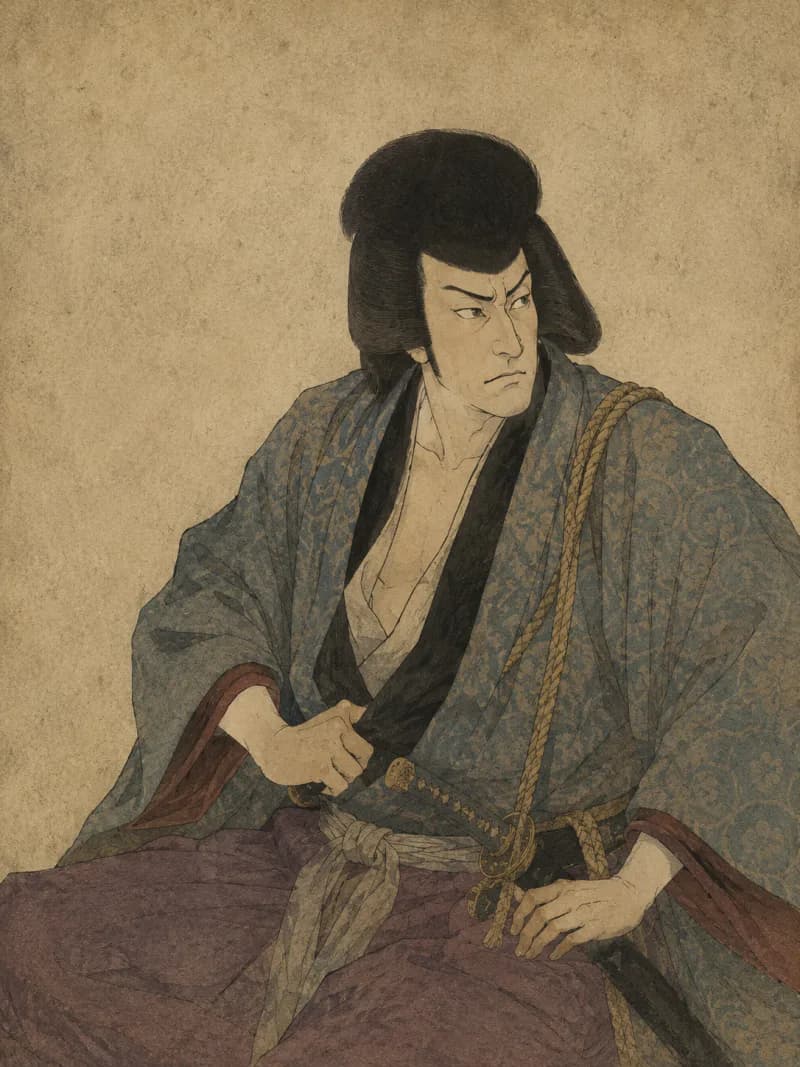
SECTION I -- SUBJECT PROFILE
| Name | Ishikawa Goemon |
|---|---|
| English | Ishikawa Goemon |
| Origin | Japan |
| Lifespan | ?–1594 |
| Gender | Male |
| Century | 16th C. |
| Clan / Role | Samurai |
| Title | Legendary great thief; ninja |
SECTION II -- OVERVIEW
Year of birth and birthplace both unknown; said to have been executed at Kyoto's Sanjō riverbed in 1594 (Bunroku 3). The method of execution was cauldron-boiling (kama-yude / kama-iri), and by tradition widely circulated from the Edo period onward, he was boiled to death in a great cauldron together with his young son.
Contemporary records that explicitly name Goemon are extremely limited, but the fact itself that around 1594 a thief was subjected to cauldron-boiling execution in Kyoto appears in fragmentary form in the records of contemporary Jesuit missionaries such as Pedro Morejón.
In Edo-period jōruri, kabuki, and fiction, the Goemon image was dramatically amplified — he was said to have sneaked into Toyotomi Hideyoshi's Fushimi Castle to steal the Chidori Incense Burner and been captured; to have been a disciple of Momochi Sandayū of the Iga-ryū ninja tradition; to have been a righteous thief and popular hero.
In modern Japanese popular culture, 'Goemon' has become the standard term for ninja, great thief, and cauldron-boiling; and through the character 'Ishikawa Goemon' in Monkey Punch's manga 'Lupin III' (set up as a descendant of Goemon), the name became known overseas as well.
A figure thin in historical fact, but indispensable as the prototype of the 'ninja-thief image' in Japanese culture.
SECTION III -- CHRONOLOGY
SECTION IV -- NOTABLE STATEMENTS
“Even should the sands of the shore of Ishikawa be exhausted, the seed of thieves in the world will not be exhausted.”
SECTION V -- FIELD NOTES
[A]The Attempted Assassination of Hideyoshi and Cauldron-Boiling — Lineage of the Tradition
The core of the Goemon image circulated in the Edo period is the story that he sneaked into Toyotomi Hideyoshi's Fushimi Castle in an attempt on his life (or to steal the Chidori Incense Burner), was captured, and was subjected to cauldron-boiling.
This scene was repeatedly performed as a famous set piece of early modern jōruri and kabuki, but there is almost no corroboration in contemporary sources.
The fact itself that a cauldron-boiling execution took place in Kyoto around 1594 appears in the records of contemporary missionaries, and this is inferred as the historical core of the Goemon execution tale.
But whether the executed person was named 'Ishikawa Goemon,' whether he attempted the assassination of Hideyoshi, and whether he was a ninja are all without contemporary corroboration.
The tradition as a whole is considered by modern scholarship a product of Edo-period narrative-making.
SECTION VI -- LEGACY & IMPACT
Ishikawa Goemon is thin in historical fact, but played a decisive role in the formation of the 'ninja-thief' image in Japanese culture.
He was repeatedly depicted in the Edo-period jōruri 'Kamabuchi Futatsu Domoe,' the kabuki 'Sanmon Gosan no Kiri,' and in modern kōdan, novels, and films, and counted as one of the 'Three Great Thieves of Japan' (Goemon, Nezumi Kozō Jirokichi, Jiraiya).
The character 'Ishikawa Goemon XIII' in the late-twentieth-century manga 'Lupin III' (serialized from 1967, by Monkey Punch) is set up as a descendant of Goemon and depicted as a samurai swordsman symbolizing Japan, and as the series has been distributed overseas, the name Goemon has come to be known abroad.
The line 'What a splendid view, what a splendid view' (Zekkei kana, zekkei kana), transmitted at the Sanmon gate of Nanzen-ji in Kyoto (the kabuki line of Goemon in 'Sanmon Gosan no Kiri'), is still used today as the standard tourist explanation of Nanzen-ji.
The historical Goemon is unknown, but Goemon as culture is the ninja-thief image of modern Japan itself.
SECTION VII -- MAJOR DEEDS
- [01]Attempted assassination of Hideyoshi (tradition)
- [02]Cauldron-boiling execution at Kyoto's Sanjō riverbed (tradition)
- [03]'Ishikawa or the sands of the shore' death poem (author unknown, formed in the Edo period)
- [04]Position in popular culture as one of the Three Great Thieves of Japan
SECTION VIII -- REFERENCE MATERIALS
PRIMARY SOURCES & ARCHIVES
- PRIMARY
Missionary Pedro Morejón Records
Jesuit records
Contemporary missionary report fragmentarily recording the execution of a thief in Kyoto around 1594
- SCHOLARSHIP
The Historical Reality of Ishikawa Goemon
Tanaka Yūko / Iwanami Shinsho
Modern Goemon study examining the distinction between historical fact and tradition
- ARCHIVE
Nanzen-ji
Sakyō Ward, Kyoto City, Kyoto Prefecture
Setting of the kabuki 'Sanmon Gosan no Kiri'; one of the transmission sites of Goemon
Visit archive →
RECOMMENDED READING
SECTION X -- RELATED REPORTS
SA-RPT
Did He Exist? Verifying Goemon's Historical Reality from the Sources
There is no doubt that contemporary Japanese share the image of 'Ishikawa Goemon.' But how far can the historical Goemon be confirmed? Distinguishing between fragments of contemporary sources and Edo-period narrative-making.
SA-RPT
'What a Splendid View, What a Splendid View': The Sanmon of Nanzen-ji and Goemon's Famous Line
A thief stands atop the Sanmon of Nanzen-ji in Kyoto and declaims 'What a splendid view, what a splendid view. The view of spring is worth a thousand pieces of gold.' The famous scene of the 1778 kabuki 'Sanmon Gosan no Kiri' is still used today as the standard tourist explanation of Nanzen-ji.
SA-RPT
Ishikawa Goemon XIII and Lupin: How Goemon Was Revived in the Twentieth Century
In 1967, Monkey Punch's manga 'Lupin III' began serialization. The character 'Ishikawa Goemon XIII' was set up as a descendant of Goemon. Tracing how the Goemon image was reconstructed in twentieth-century Japanese popular culture.
SECTION IX -- LINKED SUBJECTS
SA-0010 / JPN
Hattori Hanzō
The Iga master who guarded the founder of the Tokugawa peace
SA-0002 / JPN
Toyotomi Hideyoshi
The peasant who rose to rule all Japan
SA-0064 / JPN
Fukushima Masanori
The foremost of the 'Seven Spears of Shizugatake,' vanguard of the Eastern Army at Sekigahara, and the Hideyoshi-raised general who was stripped of his fief for repairing a castle without permission
SA-0066 / JPN
Shimazu Yoshihiro
The Satsuma general feared by the Ming army as the 'Devil Shimazu' in Korea, who broke through the enemy center at Sekigahara in the 'Sutegamari' retreat