SUBJECT FILE NO. SA-0018
BUSHI ARCHIVE
Katō Kiyomasa
Katō Kiyomasa
Lord of Kumamoto, Master Castle Builder
SECTION I -- SUBJECT PROFILE
| Name | Katō Kiyomasa |
|---|---|
| English | Katō Kiyomasa |
| Origin | Japan |
| Lifespan | 1562–1611 |
| Gender | Male |
| Century | 16th C. |
| Clan / Role | Daimyo |
| Title | Lord of Kumamoto, Master Castle Builder |
SECTION II -- OVERVIEW
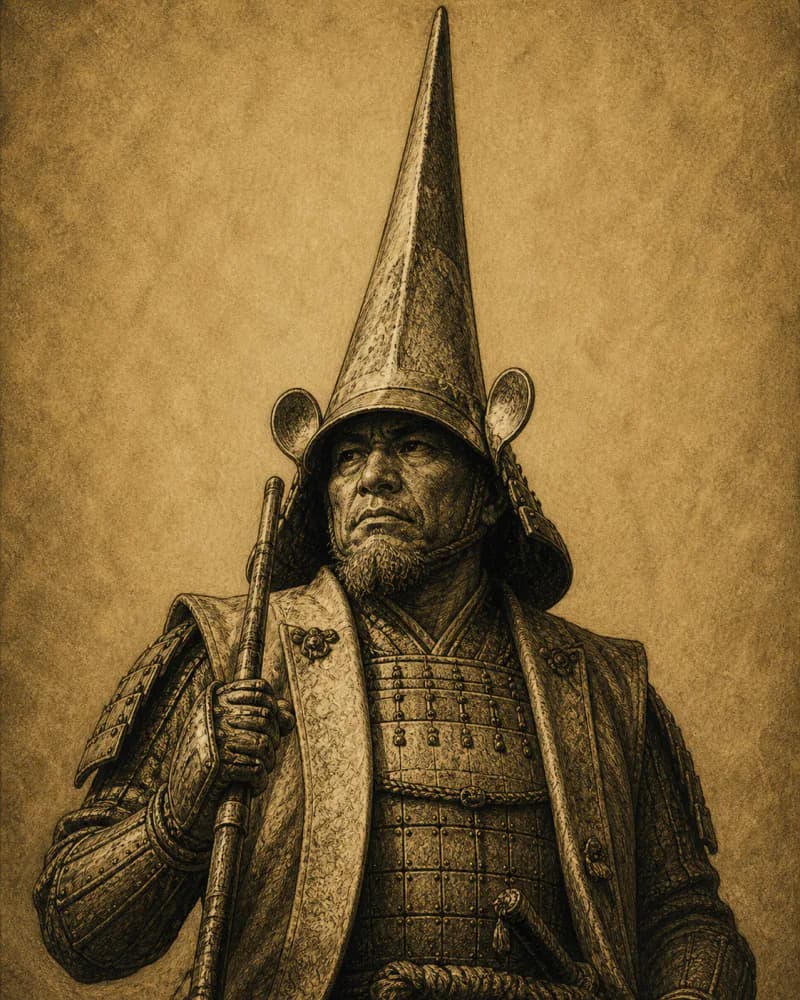
Born in 1562 in Owari Province, Kiyomasa was a distant relative of Hideyoshi and entered his service as a youth. At Shizugatake in 1583 he won fame as one of the Seven Spears, the elite vanguard who broke Shibata Katsuie's line.
In the Korean campaigns of the 1590s he commanded the right flank of the invading army and earned the nickname Tora-Gari, 'the Tiger Hunter,' for hunting Korean tigers between battles.
After Hideyoshi's death he sided with Ieyasu at Sekigahara, was confirmed at Kumamoto, and over the next decade rebuilt the city into one of the great fortresses of Japan.
Kumamoto Castle is engineering of a different order from anything else in the period — towering walls of fitted stone, false bottoms in the foundations, hidden water reservoirs, an extensive network of secret galleries beneath the keep.
The fortifications were tested two and a half centuries after his death, when Saigō Takamori besieged the castle for fifty-five days during the 1877 Satsuma Rebellion and could not take it.
Kiyomasa died suddenly in 1611, possibly poisoned, in a context that has never been fully clarified.
SECTION III -- CHRONOLOGY
SECTION IV -- NOTABLE STATEMENTS
“Build the wall as if your descendants will need to defend it three centuries from now.”
SECTION V -- FIELD NOTES
[A]The Stone Walls of Kumamoto
Kiyomasa designed the masonry of Kumamoto with curving 'mushagaeshi' walls, sloped near the base and vertical near the top, so that climbing attackers would lose their grip near the summit.
The technique is named for him in modern Japanese castle studies. The walls survived the 1877 siege intact and stand today, restored after the 2016 Kumamoto earthquakes.
SECTION VI -- LEGACY & IMPACT
Kumamoto Castle remains one of the three great castles of Japan and the most studied piece of samurai military architecture.
Kiyomasa is also remembered in his lifelong rivalry with Ishida Mitsunari, in his role as a senior Toyotomi vassal, and in the ambiguous circumstances of his death just before the Tokugawa moved decisively against the remaining Toyotomi houses.
SECTION VII -- MAJOR DEEDS
- [01]Battle of Shizugatake (1583)
- [02]Korean campaigns (1592–1597)
- [03]Construction of Kumamoto Castle (1601–1607)
- [04]Mushagaeshi wall technique
SECTION VIII -- REFERENCE MATERIALS
PRIMARY SOURCES & ARCHIVES
- PRIMARY
Zoku-sen Kiyomasa-ki
Edo-period war chronicle and principal narrative source for Kiyomasa's career
- SCHOLARSHIP
Katō Kiyomasa
Yamada Takashi / Ebisu Kōshō Shuppan
Modern biography reflecting recent scholarship (in Japanese)
- ARCHIVE
RECOMMENDED READING
SECTION X -- RELATED REPORTS
SA-RPT
Kumamoto Castle: The Castle That Outlived the Last War
Built between 1601 and 1607 by Katō Kiyomasa, Kumamoto Castle was so well engineered that 270 years later, when Saigō Takamori besieged it for fifty-five days during the 1877 Satsuma Rebellion, he could not take it. Its architecture is one of the few practical samurai legacies still readable in stone.
SA-RPT
The Seven Spears of Shizugatake: In 1583, the Twenty-Two-Year-Old Masanori Made His Name
On April 21, 1583, at Shizugatake. The young Fukushima Masanori, together with Katō Kiyomasa, Wakisaka Yasuharu, and five others, achieved the feat of first-spear and established his position as a Hideyoshi-raised warrior. Tracing the birth of the 'Seven Spears.'