SUBJECT FILE NO. SA-0013
BUSHI ARCHIVE
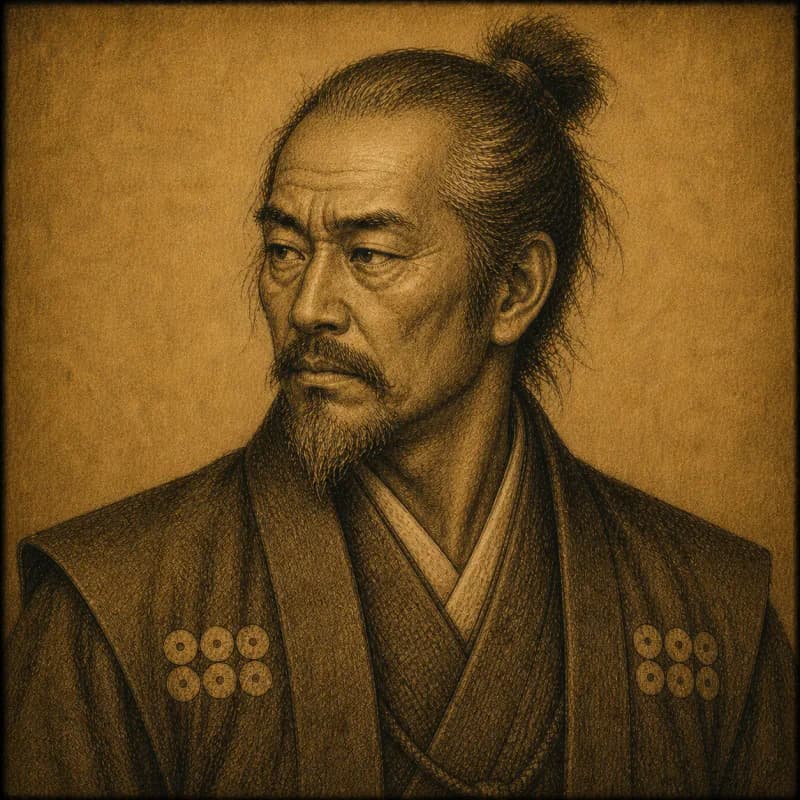
Sanada Masayuki
Sanada Masayuki
Lord of Ueda Castle
SECTION I -- SUBJECT PROFILE
| Name | Sanada Masayuki |
|---|---|
| English | Sanada Masayuki |
| Origin | Japan |
| Lifespan | 1547–1611 |
| Gender | Male |
| Century | 16th C. |
| Clan / Role | Daimyo |
| Title | Lord of Ueda Castle |
SECTION II -- OVERVIEW
Born in 1547 in Shinano Province as the third son of a minor Takeda retainer, Masayuki served Takeda Shingen as a hand-picked aide, survived the catastrophe at Nagashino, and saw his entire clan extinguished after Takeda Katsuyori's defeat in 1582.
With his father and elder brothers dead and the Sanada lands surrounded by hostile great powers, he played the surrounding daimyō — Hōjō, Uesugi, Tokugawa, then Toyotomi — against each other for fifteen years, never holding more than 38,000 koku but always retaining his independence.
His genius showed twice at Ueda Castle: in 1585 he repelled Tokugawa Ieyasu's punitive force of seven thousand with fewer than two thousand defenders, and in 1600 he stalled Tokugawa Hidetada's army of thirty-eight thousand long enough to make Hidetada miss Sekigahara entirely.
After the Western defeat he was exiled with his son Yukimura to Mount Kudo, where he died in 1611 — having never been defeated.
SECTION III -- CHRONOLOGY
SECTION IV -- NOTABLE STATEMENTS
“A small castle in difficult ground is worth more than a great castle on a plain.”
SECTION V -- FIELD NOTES
[A]The Castle That Stalled an Army
In autumn 1600, Tokugawa Hidetada was driving 38,000 men along the Nakasendō to reinforce his father at Sekigahara.
Masayuki, with three thousand, used Ueda's ravines and false retreats to draw Hidetada into an eight-day siege.
By the time Hidetada disengaged, Sekigahara was already over — his absence nearly cost his father the realm.
SECTION VI -- LEGACY & IMPACT
Masayuki defined a particular Japanese ideal of strategic excellence: the small lord using terrain, deception, and discipline to fight far above his weight.
The Sanada family motto Hyaku-bu Hyaku-shō ('a hundred parts, a hundred victories') is taught in modern leadership courses, and his unbroken record made his sons — Nobuyuki and Yukimura — into legends of opposite kinds.
SECTION VII -- MAJOR DEEDS
- [01]First Battle of Ueda (1585)
- [02]Second Battle of Ueda (1600)
- [03]Sanada military doctrine of mountain defense
- [04]Diplomatic balancing among five rival daimyō (1582–1600)
SECTION VIII -- REFERENCE MATERIALS
PRIMARY SOURCES & ARCHIVES
- PRIMARY
Sanada Family Documents
Held by Ueda City Museum and Matsushiro Sanada Treasury
Hereditary Sanada-clan documents including Masayuki's autograph correspondence
- SCHOLARSHIP
The Three Generations of Sanada
Hirayama Yū / PHP Shinsho
Modern study tracing Masayuki, Nobuyuki, and Nobushige (in Japanese)
- ARCHIVE
Matsushiro Sanada Treasury
Nagano City
Comprehensive archive of Sanada-family heirlooms
Visit archive →
RECOMMENDED READING
SECTION X -- RELATED REPORTS
SA-RPT
Sekigahara: How Tokugawa Won Japan in a Single Afternoon
On October 21, 1600, two armies of roughly 80,000 men each met in fog on a Mino plain. By sunset, the battle that decided 250 years of Japanese history was over.
SA-RPT
Ueda Castle: How Three Thousand Stopped Thirty-Eight Thousand
Twice — in 1585 and again in 1600 — Sanada Masayuki defended a small Shinano castle against Tokugawa armies many times his size. The second defense changed Japanese history. The first showed how he did it.
SA-RPT
The Brother Who Outlived the Legend: Why Sanada Nobuyuki Lived to Ninety-Two
Sanada Yukimura died at Osaka in 1615, a hero. His older brother Nobuyuki — who had sided with the Tokugawa at Sekigahara — outlived him by forty-three years and built a domain that lasted to the Meiji Restoration. The contrast tells you what samurai loyalty actually required.