SUBJECT FILE NO. SA-0015
BUSHI ARCHIVE
Musashibō Benkei
Musashibō Benkei
Sōhei of Mount Hiei, Retainer of Minamoto no Yoshitsune
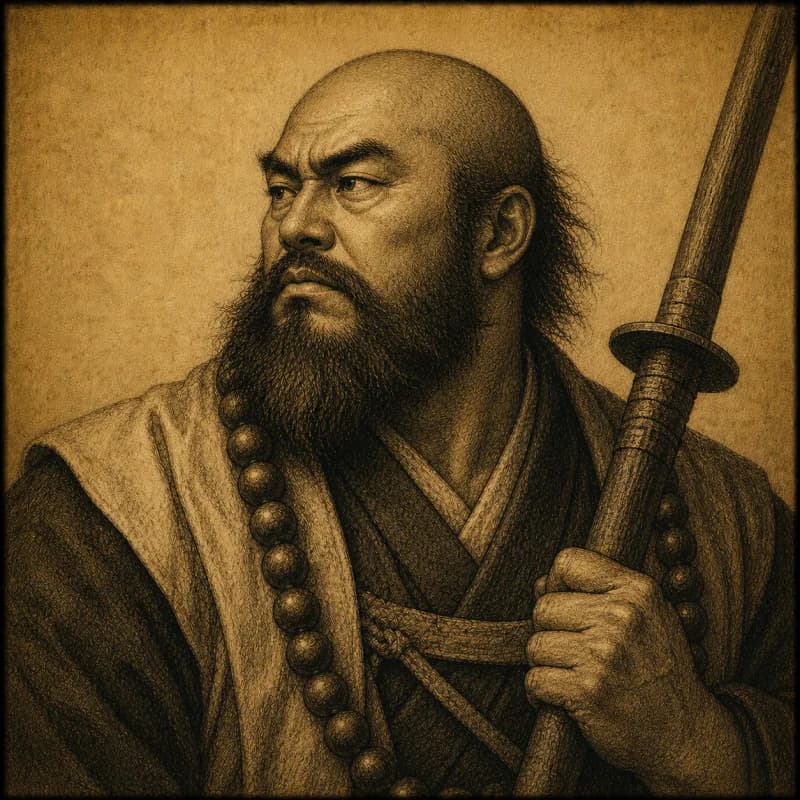
SECTION I -- SUBJECT PROFILE
| Name | Musashibō Benkei |
|---|---|
| English | Musashibō Benkei |
| Origin | Japan |
| Lifespan | 1155?–1189 |
| Gender | Male |
| Century | 12th C. |
| Clan / Role | Swordsman |
| Title | Sōhei of Mount Hiei, Retainer of Minamoto no Yoshitsune |
SECTION II -- OVERVIEW
Benkei is half-history, half-myth: a warrior monk born around 1155, said to have been raised on Mount Hiei, who collected swords from samurai he defeated on Gojō Bridge in Kyoto until he met Minamoto no Yoshitsune — to whom he lost on the thousandth duel and pledged his life.
From that moment until both their deaths he was Yoshitsune's inseparable retainer through the Genpei War, the climactic battles at Ichi-no-Tani, Yashima, and Dan-no-ura, and the final flight north when Yoshitsune fell out with his half-brother Yoritomo.
Trapped at Koromogawa in 1189 with their lord performing seppuku in an inner room, Benkei is said to have stood at the bridge alone, killing every attacker who came near, until he died on his feet — pierced by so many arrows that he resembled a porcupine and the enemy thought he was still alive.
The 'Standing Death of Benkei' (Benkei no tachi-ōjō) became proverbial: dying without falling, a final act of will.
SECTION III -- CHRONOLOGY
SECTION IV -- NOTABLE STATEMENTS
“Even in death I will not yield to my lord's enemies.”
SECTION V -- FIELD NOTES
[A]The Standing Death
Surrounded at the Koromo River, Benkei stood at the only bridge to the temple where Yoshitsune was preparing his end.
He fought with a naginata until both arms were broken, then with a fallen sword, then kneeling. When the enemy finally dared approach, they found him already dead but still upright, body bristling with arrows like a pine tree.
The image entered every later samurai legend.
SECTION VI -- LEGACY & IMPACT
Benkei is the founding archetype of the Japanese loyal retainer — the figure to whom every later vassal-poet, every 47-rōnin tale, every kamikaze pilot's farewell letter eventually traces.
He is also the godfather of the Japanese 'tragic hero' literary form (hangan-biiki, 'sympathy for the underdog'), and remains one of the most-staged figures in kabuki and noh.
SECTION VII -- MAJOR DEEDS
- [01]Genpei War campaigns (1180–1185)
- [02]Standing Death at Koromogawa (1189)
- [03]Subject of Kanjinchō, Funa-Benkei, and dozens of noh and kabuki plays
- [04]Origin of the term Benkei no tachi-ōjō
SECTION VIII -- REFERENCE MATERIALS
PRIMARY SOURCES & ARCHIVES
- PRIMARY
Gikeiki (Tale of Yoshitsune)
Muromachi-period text, the principal classical source for Yoshitsune and Benkei legends
- SCHOLARSHIP
Minamoto no Yoshitsune
Gomi Fumihiko / Iwanami Shinsho
Standard biography by a leading medievalist; Benkei is a major subject (in Japanese)
- ARCHIVE
Hiraizumi Cultural Heritage Center
Hiraizumi Town, Iwate Prefecture
Materials relating to Yoshitsune and Benkei's final stand at Koromogawa
Visit archive →
RECOMMENDED READING